


There are many ways to align the head on your Bridgeport style Mills with the table, this is my preferred method.
Having proper alignment is critical to many operations, such as, boring, drilling, reaming, facemilling, and sidemilling. If the head or column of a Mill is not square with the table, a taper will be machined into the part. We have all experienced a step in the face of a part we are trying to surface, or a part that measures different at the top compared to the bottom. Starting with a square foundation goes a long way toward making good parts. Bridgeport's are extremely versatile machines, the number of articulating joints is fantastic, but these degrees of freedom come at a cost. Tilt, pivot, or reposition your head and prepare for a lesson in tramming.
The level of alignment needed varies from part to part, perhaps simply using a square held to the quill is sufficient for your needs. The same process can be used for Vertical Machining Centers, with the exception that leveling feet do the adjusting. (Unless the column is terribly out of square)
I’m was halfway through a run of parts that were fighting me to no end. I switched from a solid carbide 3/4” Dorian bar to an MAQ 3/4" vibration damped with the same parameters. The part on the right in the picture below is the result.
The videos you see online of these bars are the real thing. I've had the same experience in my shop. Just today we machined some parts with a bore 5.5" deep. We used a 3/4" boring bar with a 5.75 stickout. Didn't even change the finishing feeds and speeds from what we would normally run. Roughed and finished with the same bar. It actually broke a chip too! We're willing to do parts that we would have avoided before.
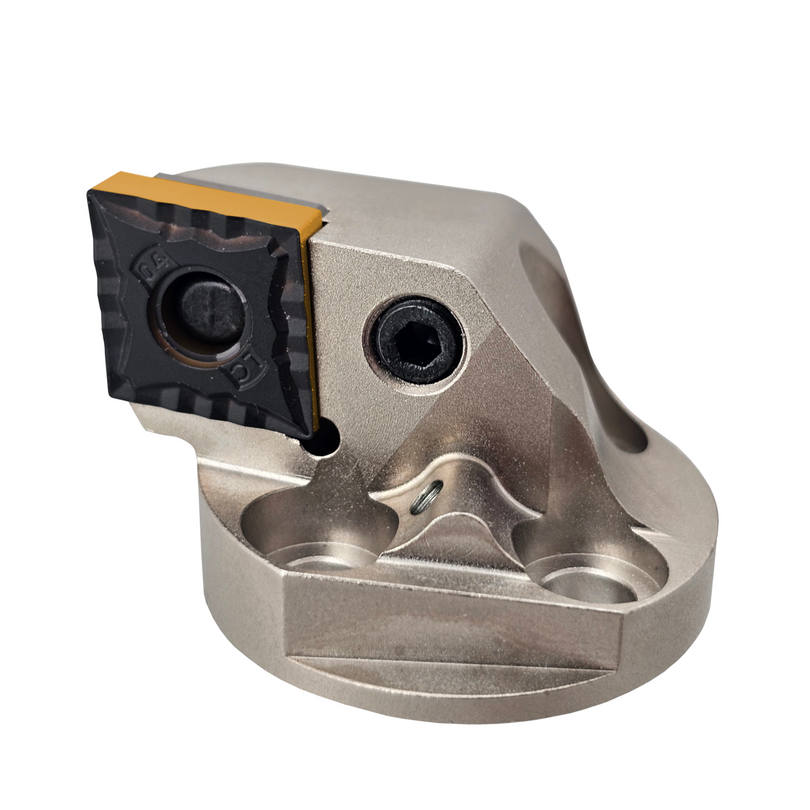
We were struggling to get good finishes and tool life in a bronze alloy recently. We had been using a comparable DCGT insert from a reputable company with very little success. We could only get one or two parts before having to rotate the insert to a new edge. We were also running recommended speeds and feeds from this other vendor. Octane suggested we try these Arno inserts for non-ferrous. We were skeptical at first as the Arno inserts looked almost identical to the other brand we were using, but the grind and the edge on the insert was much sharper than the other brand. The coating was also more even and the packaging was excellent. We made no speed and feed adjustments from what was being used with the other brand and we were able to get 10 pieces per edge in this bronze material. The edge held up and after those 10 pieces had some signs of wear, but it was very minimal. I would have no issues running the Arno brand of inserts again and plan to use them more as we machine more of these bronze components. My only complaint would be having to buy a package of 10, it would be nice to have the option to only get 5, especially if you needed them for a one off job.